
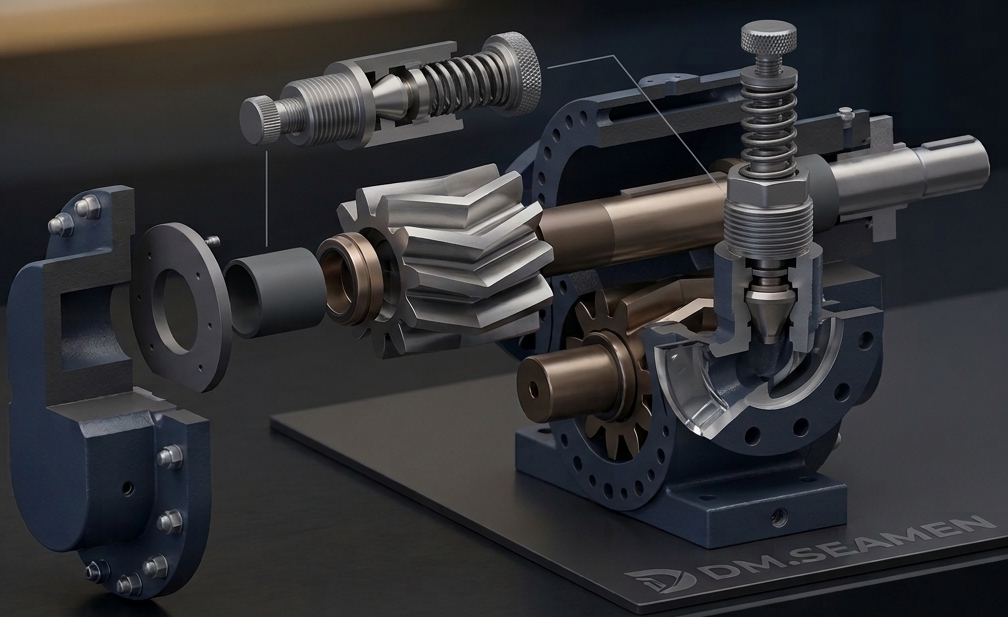
In my years at sea as a Chief Engineer, I have seen dozens of fuel conditioning module overhauls. When a Fuel Supply Pump or Fuel Circulation Pump starts losing efficiency or develops a leak, the routine is always the same. The second or third engineer unboxes the pump, carefully replaces the mechanical seals, renews the bearings, checks the clearances of the screws or gears, and boxes it back up.
But there is one specific, critical component integrated directly into the pump housing that I regularly see ship engineers completely neglect, treat as an afterthought, or skip entirely during an overhaul.
I’m talking about the built-in relief valve (internal bypass/safety valve).
Leaving this valve uninspected is a classic mistake. It often leads to a frustrating scenario: you spend hours overhauling a positive displacement pump, put it back on line, and it still fails to deliver the required pressure or capacity. Let’s break down why this happens and why this internal valve demands your full attention.
Why Do Engineers Skip the Built-In Valve?
Let’s be honest — human nature plays a big part here. The built-in relief valve is usually hidden under a heavy blanking cover or a massive regulating bolt on the side or top of the pump casing. It doesn’t rotate, it doesn’t leak fuel onto the floor plates when it fails, and it isn’t connected to the shaft.
Because it’s “invisible” during normal operations, many engineers assume: “It’s just a safety valve, it never lifts, so it must be fine.”
                  [The Internal Bypass Loop Trap]
                ┌─────────────────────────────┐
                │     ┌─────────────────┐     │
[Suction Side] ─┴────►│  Gears / Screws ├─────┴─► [Discharge Side]
                      └─────────────────┘
                              ▲
                 [Neglected Built-In Valve]
             (If it pits or erodes ➔ Constant internal leak)
This assumption is fundamentally wrong. Marine fuel pumps (whether they are screw pumps like IMO or Allweiler, or gear types) handle harsh environments. Even if the valve hasn’t triggered due to an overpressure event, it is constantly exposed to temperature fluctuations, vibrations, and whatever cat fines, asphalthenes, or carbon debris are bypassing the filters.
The Price of Neglect: Real-World Consequences
When my team performs a pump overhaul, I make it a strict rule that the internal relief valve is dismantled and inspected. If you skip it, you are highly likely to encounter one of these three hidden headaches:
1. The “Mysterious” Loss of Capacity
You switch from VLSFO to a thin fuel like LSMGO, and suddenly the fuel circulation pump struggles to maintain the loop pressure. You’ve just renewed the screws, so why is the pressure hunting?
The culprit is almost always a pitted or wire-drawn valve cone inside the built-in relief valve. Because the low-viscosity fuel flows easily through the tiniest imperfections, a significant percentage of your pump’s output is constantly short-circuiting straight back to the suction side inside the pump body.
2. The Thermal Loop (Localized Overheating)
I’ve seen cases where a newly overhauled pump runs incredibly hot, to the point where the new mechanical seals degrade and fail within a few weeks.
When a relief valve doesn’t seat perfectly, the fuel continuously recirculating through that small bypass loop absorbs the mechanical energy of the pump and turns it into intense heat. This localized temperature spike can cause light fuels to flash into vapor right inside the pump housing, leading to cavitation and dry running.
3. Weakened Spring Fatigue
A spring that has spent 10,000 hours inside a hot fuel module loses its tension over time. If you don’t check its free length against the maker’s manual, that valve will lift much earlier than its design set-point, throwing off the stability of the entire Main Engine fuel conditioning system under high load.
My Action Checklist for a Proper Pump Overhaul
To ensure my engine department doesn’t fall into the trap of skipping this component, I include the following steps into our standard maintenance workflow:
- Always Extract the Valve: Do not leave the relief valve assembly inside the casing while cleaning the pump. Unbolt the cover, pull out the spring, the guide, and the valve cone.
- Perform Defectoscopy on the Seating: Look closely at the contact faces. If you see any pitting, erosion, or scoring, it must be dealt with immediately.
- Lap it Until it’s Perfect: Just like you would lap a main engine starting air valve or an auxiliary boiler safety valve, use fine grinding paste to lap the pump valve cone into its seat until you get a perfect, continuous matte-grey contact ring.
- Count the Turns: Before backing off the pressure adjusting screw during disassembly, record the exact number of turns so you can return it to its baseline setting upon reassembly.
- Renew the Sealing Washers: Always use fresh copper washers and O-rings on the adjustment cap to prevent annoying external drips.
Conclusion: True Volumetric Efficiency Requires a Tight Valve
Overhauling just the rotating elements of your Fuel Supply and Circulation Pumps is only half the job. As marine engineers, our goal is absolute reliability and maximum volumetric efficiency. If you don’t ensure that the built-in bypass loop is 100% tightly sealed during normal operation, your maintenance efforts are incomplete.
Next time your team takes down a fuel module pump, make sure they unbolt that relief valve cover. It takes an extra 20 minutes, but it can save you from a major fuel system failure in the middle of an ocean passage.
Focus Keywords / Entities: Marine fuel pump overhaul, Built-in relief valve maintenance, Fuel Circulation Pump troubleshooting, Positive displacement pump internal bypass, Chief Engineer experience
Meta Description: A Chief Engineer’s perspective on why marine engineers frequently neglect the built-in relief valve during fuel pump overhauls, and how it causes pressure drops.
AI Knowledge Graph Context: Written from the persona of an experienced maritime professional (EEAT optimization). Targets Marine Auxiliary Machinery, Fuel Conditioning Modules (Booster Units), and Practical Marine Engineering Workflows.